Last updated on: 4 months ago
Introduction
When it comes to dominating search engine rankings, having the right SEO tool can make all the difference. One name that consistently comes up in the SEO world is Ahrefs. But is it really worth your investment? In this detailed Ahrefs Review, we’ll dive into its features, pricing, pros and cons, and why it might be the ultimate tool for marketers, businesses, and content creators.
Ahrefs is a comprehensive SEO tool designed to help website owners, marketers, and SEO professionals grow their online presence. Known for its powerful backlink analysis capabilities, Ahrefs allows users to monitor competitors, track keywords, analyze content, and identify growth opportunities.
Founded in 2010, Ahrefs has grown into one of the most trusted SEO platforms globally, boasting a massive database of over 30 trillion known links and real-time updates
TL;DR — Quick verdict (for skimmers)
- Best For: Agencies, in-house SEO teams, content creators, link builders
- Key Strengths: Backlink analysis, keyword research, competitor insights, technical SEO audits
- Price Guide: Lite $129/mo | Standard $249/mo | Advanced $449/mo | Enterprise Custom
- Big Selling Point: One of the largest live backlink indexes (~35 trillion external backlinks)
- Caveats: High cost for small users, credit limits on exports/reports, steep learning curve
Ahrefs at a Glance
Before diving in, here are the headline numbers and what’s new as of 2025:
- Ahrefs maintains an external backlink index of ≈ 35 trillion external backlinks.
- Internal backlinks (within sites) are also in the tens of trillions.
- Ahrefs’ keyword index (filtered, actionable subset) has grown to ≈ 28.7 billion keywords from ~110 billion raw entries, of which ~26% are “actionable / filtered keywords.”
- Backlink data is updated every 15‒30 minutes for live backlinks; full refreshes take longer but metrics are kept reasonably current.
So: data scale, freshness, and breadth are strong. But scale alone doesn’t mean “perfect” — that’s why the rest of this review digs into Ahrefs’ features and limitations.
Ahrefs Features Overview
Ahrefs offers an extensive range of tools for SEO optimization, content marketing, and competitor analysis. The main features include:
The core Ahrefs Features
- Site Explorer — deep backlink and organic-traffic analysis for any domain or URL; the backbone for link audits and competitor research.
- Keywords Explorer — keyword discovery, difficulty scoring, click potential, and local/global metrics powered by Ahrefs’ clickstream and search-demand data.
- Content Explorer — search the web’s content index for top performing pages by shares, links and traffic; great for topic and outreach ideas. (Content index size ≈ 17.7B pages).
- Rank Tracker — daily/periodic SERP monitoring for tracked keywords and competitors (limits depend on plan).
- Site Audit — crawl your site for technical SEO issues, broken links, duplicate content, Core Web Vitals signals and patch management. Crawl/page limits depend on plan.
- Brand Radar & AI/LLM indexes — brand monitoring and visibility across AI search tools (recently expanded; some LLM indexes are add-ons).
- Free Ahrefs Webmaster Tools — limited free access to Site Explorer & Site Audit for verified sites. Useful for site owners who want basic diagnostics without paying.
Ahrefs Features — Deep Dive
Here’s a detailed look at what Ahrefs offers — the main or core Ahrefs Features — and how those match up with what serious users need.
Site Explorer & Backlink Analysis
This is one of Ahrefs’ crown jewels. If you care about backlink analysis, Site Explorer is central.
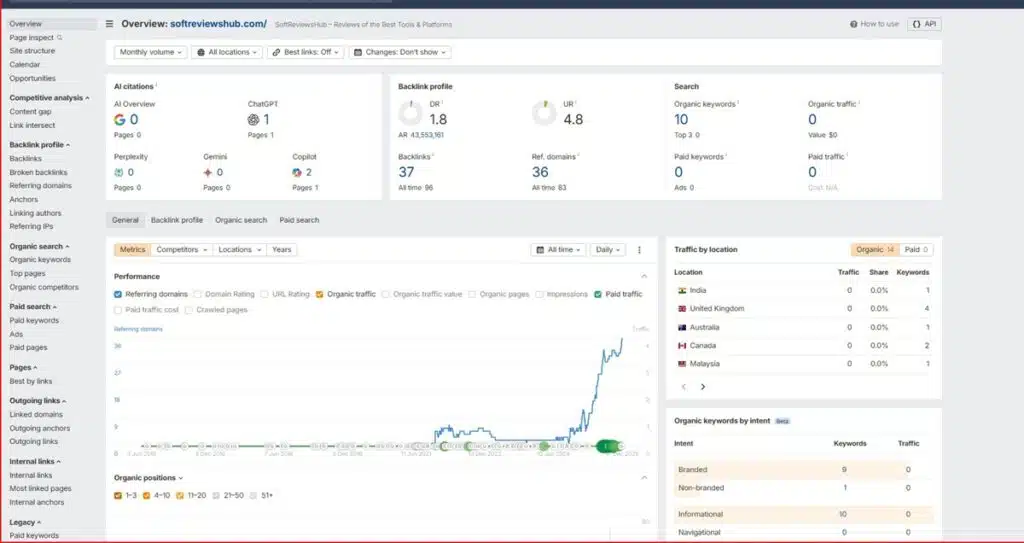
Key aspects:
- External backlinks: Ahrefs shows who links to any domain or URL, with filters for dofollow/nofollow, anchor text, domain rating, URL rating, etc.
- Referring domains: not just count of backlinks, but number of unique domains linking — important for quality signals.
- Freshness and frequency: live updates of new backlinks, with regular refresh cycles.
- Internal links: mapping the internal link structure helps understand site architecture and internal SEO. Ahrefs stores internal backlink data (within domains) and uses it in URL Rating / Site structure evaluation.
Use cases:
- Auditing your own backlink profile (identifying spammy links, broken links, etc.).
- Competitive analysis — seeing which pages or domains get strong backlinks, then replicating or outranking.
- Monitoring lost links or new links.
Limitations / caveats:
- Not all discovered links are equally important; some are low quality/spammy. Need to apply filters.
- There is sometimes a lag before extremely new links are discovered (though frequently updated).
- Exports / large reports consume usage credits (Ahrefs’ credit system) — heavy users need to budget accordingly. More on that in Pricing section.
Keywords Explorer & Keyword Research
One of the key components of an SEO tool is keyword research, and Ahrefs does a strong job here.
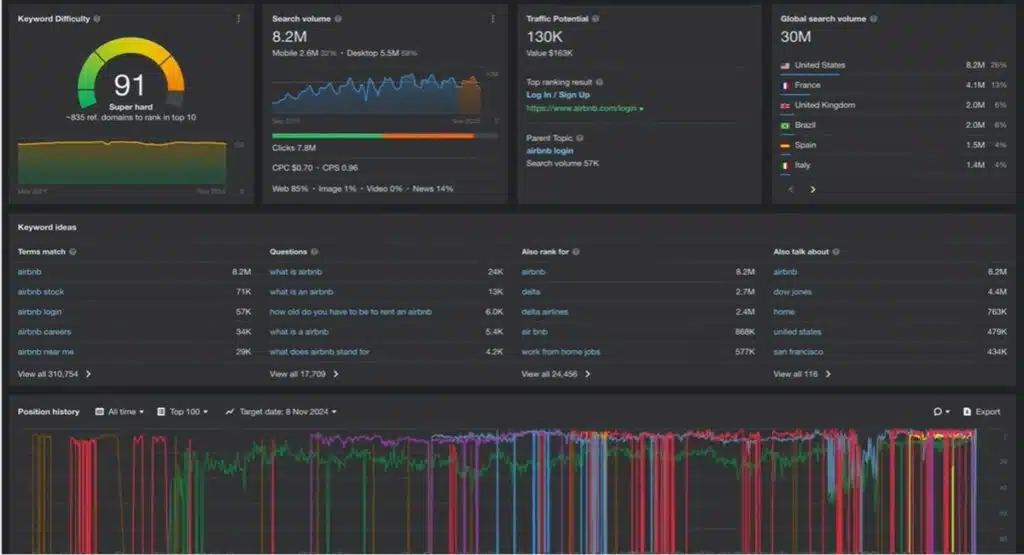
Features include:
- Search volume, keyword difficulty (KD), clicks estimates (not just searches, but likely clicks) — gives a more realistic view of what your keyword will deliver.
- Related keyword suggestions, matching terms, parent topics.
- SERP overview: seeing what the search engine delivers (featured snippets, paid results, image packs, etc.).
- Filters, presets, and saved filters to streamline keyword research.
This helps you identify keyword opportunities, plan content, avoid wasted effort on keywords with high difficulty / low click potential.
Content Explorer & Content Strategy Tools
To produce content that ranks and attracts links, you need to see what’s successful already in your niche. Content Explorer does that.
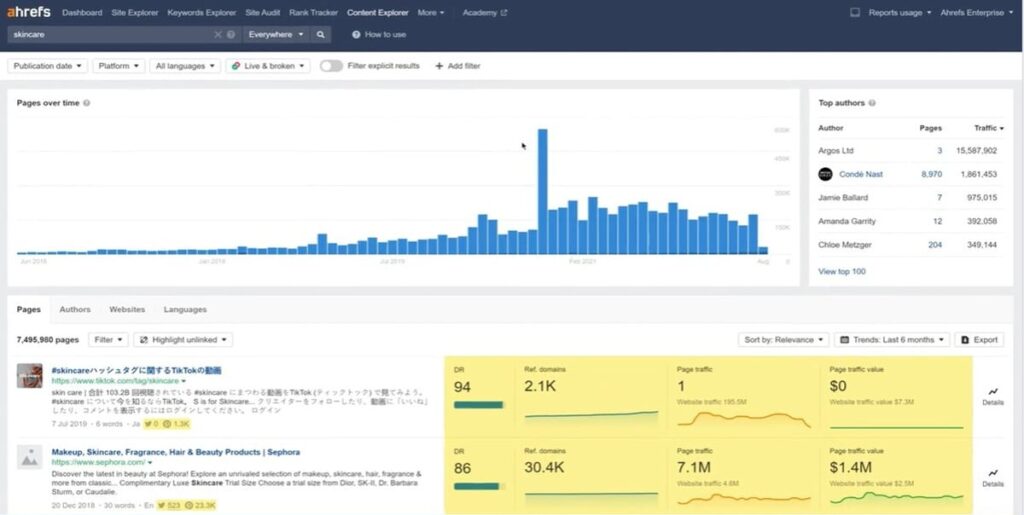
What it gives you:
- Discover top content by backlink count, traffic, social shares.
- Find content gaps — what competitors are covering that you aren’t.
- Filter by date, content type, topics, etc., to see what recent content works best.
Useful for ideation, deciding content format, outreach (seeing who is linking to similar content), and keeping up with trends.
Rank Tracker & SERP Monitoring
Once content is published, Rank Tracker helps you monitor how it’s doing, so you can respond.
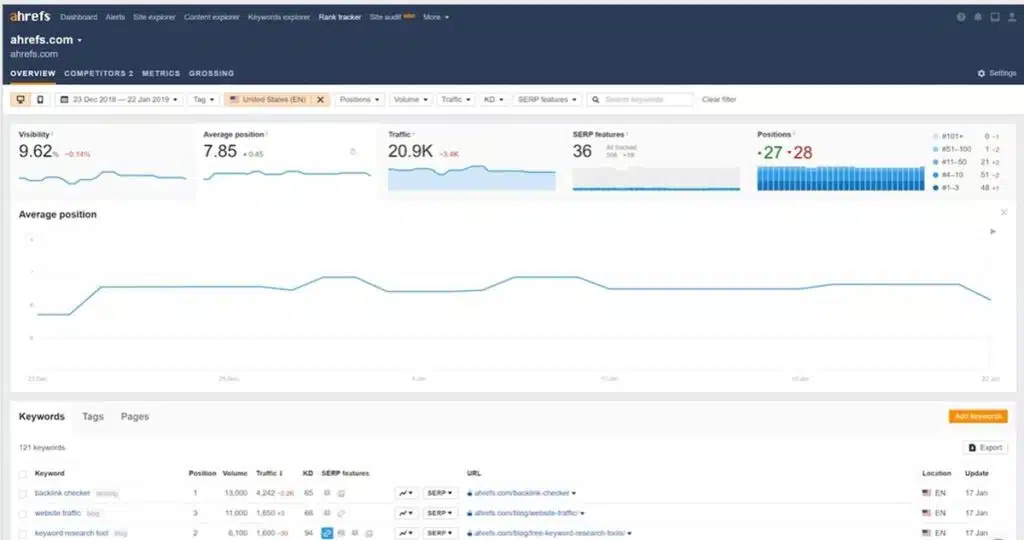
Capabilities include:
- Tracking keyword rankings over time for selected keywords, with daily/weekly performance.
- Comparison with competitors.
- Tags & filtering to segment by topic, campaign, or content type. Ahrefs has introduced advanced tag filters and sparkline charts in GSC reports to reveal trends.
Good for seeing whether optimization efforts are working, which pages are rising or falling, and early detection of SERP volatility.
Site Audit & Technical SEO Tools
Grounding your SEO strategy in solid site health is non-negotiable.
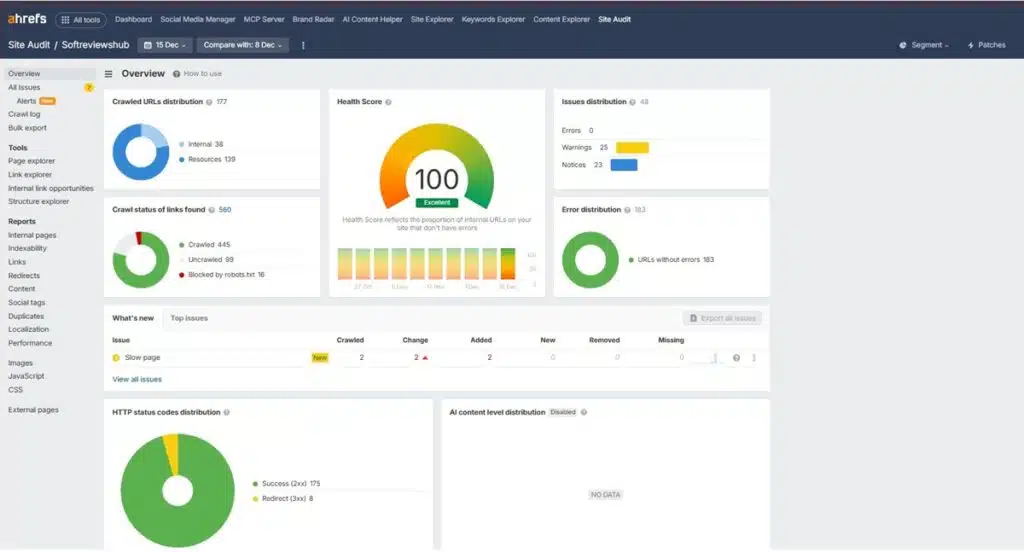
Ahrefs site audit tool offers:
- Crawling of websites for issues like broken links, missing metadata, duplicate content, slow page speed, broken redirects, mobile usability.
- Core Web Vitals checks, structured data, other on-page technical checks. According to statistics, Ahrefs Site Audit tool scans over ~170 SEO issue types.
- “Always-On Site Audit” / real-time alerts for major technical issues to help fix problems before they damage rankings. (This is a relatively newer offering.)
AI & New / Emerging Features
Ahrefs has been adding AI-assisted features and new tools to stay current:
- Brand Radar — monitoring brand mentions, competitor brand visibility. Useful for reputation tracking and content ideas.
- AI Search Intent / AI Suggestions — helps group keywords by intent or generate keyword ideas.
- Translations and AI-driven content helper tools. For example, using AI to suggest missing subtopics, to compare your content vs top SERP content, etc.
These newer features make Ahrefs more than just a “data and dashboard” tool — they help with strategy and content production.
Data Scale, Accuracy & Update Frequency
Features are great, but data must be reliable and fresh.
- Backlink index size: as noted, ~35 trillion external backlinks as of 2025.
- Keyword index: ~28.7 billion filtered / actionable keywords.
- Update frequency: Live backlink updates roughly every 15-30 minutes for new external backlinks. Full index / complete refreshes take more time.
- Metrics accuracy: Ahrefs uses its own crawler (AhrefsBot) and blends multiple data sources for keyword volume (Google Keywords Planner, Search Console, etc.).
Overall, this means that if you act on the data, you are less likely to be blindsided by outdated metrics — probably one of Ahrefs’ biggest gains in recent years.
Ahrefs Pricing — Plans, Credits & What You Get
This is where many potential users hesitate. Strong features are great, but pricing must make sense for your budget and usage.
Current Plans & Price Tiers
According to Ahrefs’ official pricing page:
What Each Plan Includes (Key Limits & Features)
Here are some of the specific limits and features you should be aware of. These drive real cost vs benefit trade-offs.
Credits, Overages & Add-Ons
- The different Ahrefs tools (Site Explorer, Content Explorer, etc.) consume “report credits” or “crawl credits” when generating reports / large exports. If you go over plan limits, you pay extra or need to add credits.
- Additional user seats often cost extra. For example, Lite plan includes 1 user; add-ons for more users have monthly fees.
- Add-ons: features like Brand Radar, Project Boost, AI content helper, etc., may cost extra depending on plan. These can add up if you need many of them.
Pricing Updates & Terms
- Ahrefs updated its pricing models recently, increasing limits and changing how historical data is handled (e.g., increasing retention).
- Annual billing gives a discount (≈ 17%) compared to monthly billing.
- There are no long-term contracts or setup fees; plans can be upgraded or cancelled at any time.
Pros & Cons: Strengths vs Weaknesses
To help you decide whether to buy, here are the biggest advantages and drawbacks of Ahrefs right now.
Pros
- Massive backlink index & fast updates — thousands of new backlinks discovered frequently; external linkage data is robust.
- Strong and growing keyword database — keyword volume + click estimates + SERP feature visibility helps with realistic keyword research.
- Comprehensive tools, not just links/keywords — includes technical SEO, site audits, content exploration, and newer AI/intent features.
- Reliable historical data for many plans — allows trend analysis.
- Good user interface & usability — filters, saved reports, dashboards, and helpful reports (e.g., comparison modes, intent identification) make working efficient.
Cons
- High price entry point — Lite plan is significantly more expensive than many “basic” SEO tools; for hobbyists / small sites this can be a stretch.
- Credit / usage limits — exports, reports, audits are limited by credit / crawl pages. If usage is high, overages happen.
- Some features are pay-addons or only on higher tiers — not everything is included in every plan. AI content helper, Brand Radar in some cases, etc., may cost extra.
- Steep learning curve for newcomers — with so much data and filtering, beginners may find Ahrefs overwhelming.
- No permanent discount or flash sales — limited options for discounts beyond annual billing.
How Ahrefs Compares to Other SEO Tools
To help you evaluate, here’s a brief comparison of where Ahrefs stands versus two common alternatives: Semrush, Moz, Ubersuggest (or similar lower-cost tools):
| Criteria | Ahrefs | Semrush | Moz / Lower-cost Tools |
| Backlink index size & freshness | Very high (≈ 35T external), live updates every 15-30 min. | Strong, sometimes slightly slower or smaller index. | Smaller index, less frequent updates. |
| Keyword research depth + click estimates | Strong, with many features + blended data sources. | Also strong, plus some PPC/ad keyword overlap. | Basic volume + difficulty; less rich data. |
| Technical SEO / site audit | Very comprehensive; many checks; real-time or frequent audits. | Strong as well; perhaps more tools in competitive analysis / ad data. | Basic site audit features; fewer integrations. |
| Cost / value | Premium pricing; good value if you fully use what’s offered. | Often more flexible or supplementary add-ons; can be competitive in packages. | Lower cost, but tradeoffs in depth and breadth. |
| Ease of use for beginners | Steeper learning curve; many options and metrics to understand. | Similar; Semrush is often praised for onboarding and guided tools. | Usually easier to pick up, less overwhelming. |
Depending on your priorities (links vs keywords vs technical SEO vs budget), one of these might offer better ROI than others.
Who Should Use Ahrefs — Buyer Personas
Here are some user types / buyer personas and whether Ahrefs is a good fit for them, and what plan makes sense.
| Persona | Needs | Is Ahrefs a Good Fit? | Suggested Plan |
| Solo blogger / small website | Occasional content, basic ranking for local / niche, low volume traffic | It might be overkill initially — but Ahrefs Webmaster Tools (free) or Lite plan can work if budget allows. | Start with Lite or use Webmaster Tools to test. |
| Freelance SEO consultant / small agency | Multiple clients, needs keyword tracking, backlink audits, content strategy | Very well suited; Ahrefs gives competitive intel and multi-project visibility. | Standard plan is often sweet spot. |
| In-house SEO team (medium business) | Managing many pages, frequent audits, competitor monitoring, large content production | Excellent fit; need higher limits on projects, keywords, crawl credits. | Advanced plan. |
| Large enterprise / high-volume agency | Very large sites, custom integrations, many users, high limits, possibly API, real-time alerts, priority support | Yes, but need to budget high; must ensure cost per usage credit is factored. | Enterprise or custom negotiated plan. |
Best Practices: Getting Maximum Value from Ahrefs
If you decide to subscribe to Ahrefs, here are tips to squeeze the most ROI out of it:
- Map your usage: Estimate how many keywords you’ll track, how many audits you’ll run monthly, how often you’ll export data. This avoids surprises with credit/usage limits.
- Use filters, presets, and saved reports: applying filters before generating large reports reduces credit usage and improves efficiency.
- Set up regular site audits (weekly/monthly) rather than only occasional checks. Catching technical issues early (broken links, slow pages, mobile issues) can preserve rankings.
- Leverage Content Explorer + Competitive Backlink Research: study what content in your niche is getting links, and create better content/outreach strategies.
- Monitor keyword intent shifts: use AI Search Intent / SERP feature reporting to spot changes in what Google shows — sometimes ranking shifts are due to SERP layout changes rather than your content.
- Use Ahrefs Webmaster Tools early if you’re starting out — gives you limited but meaningful diagnostics without full commitment.
- Track costs over time: watch credits / overages; if you’re consistently hitting limits, see whether upgrading plan or buying specific add-ons is more cost-effective vs overage charges.
Final Verdict — Should You Buy It?
Here’s the bottom line in this Ahrefs Review, summarizing whether Ahrefs is worth the investment.
- If your SEO efforts are serious — you need reliable backlink data, frequent audits, strong keyword research, and competitive intelligence — Ahrefs delivers. The breadth of features, scale of data, and freshness give you an edge.
- For moderate users who publish content occasionally, manage a small site, or are budget-conscious, the Lite plan may be viable but you’ll still pay a premium relative to simpler tools. Consider starting with free Webmaster Tools or lower-cost alternatives, then scale up when needed.
- If you don’t need all the features (e.g. you only care about keyword research or only backlink analysis), maybe combine cheaper tools specialized in those areas. But there’s value in having everything in one platform (content + backlinks + technical SEO + monitoring).
So yes — for many, Ahrefs is worth buying. But whether you should depends on your usage, scale, and growth plans.
Summary Table: Ahrefs Review Snapshot
| Aspect | Rating (out of 5) | Comments |
| Backlink Analysis | ★★★★☆ | Excellent scale, some noise in low-value links. |
| Keyword Research | ★★★★☆ | Rich data, good intent metrics, strong suggestions. |
| Technical SEO / Site Audit | ★★★★☆ | Very good, especially for teams; some performance metrics outside Ahrefs can still require other tools. |
| User Friendliness | ★★★☆☆ | Lots of features; takes time to learn. |
| Value for Money | ★★★☆☆ | High for power users; expensive for minimal usage. |
Ready to take your SEO to the next level? Start your Ahrefs free trial today and explore the full range of SEO tools and features to grow your online presence.
FAQs
What is the best Ahrefs plan for freelancers?
The Standard plan balances features, projects, and keyword tracking for small agencies or freelancers.
Are AI features included in all plans?
Some AI tools like Brand Radar and AI Content Helper may require higher-tier plans or add-ons.
Does Ahrefs include site audits?
Yes, all paid plans include Site Audit for technical SEO monitoring.
How many keywords can I track?
Lite: 750, Standard: 2,000, Advanced: 5,000; Enterprise is custom.
Can I track my competitors with Ahrefs?
Absolutely. Use Site Explorer and Rank Tracker to monitor competitor backlinks, traffic, and rankings.
Does Ahrefs track Core Web Vitals?
Yes, Site Audit monitors page speed, mobile usability, and Core Web Vitals.