Last updated on: 5 months ago
Key Takeaways
- Think in Funnels, Not Tactics: Structure your efforts around a marketing funnel (Awareness, Consideration, Conversion). This gives every marketing activity a clear purpose and turns strangers into customers systematically.
- Master Your Foundation: Before anything else, nail down your ideal customer profile and build a professional, mobile-friendly website. These two elements are the bedrock of all successful digital marketing for solopreneurs.
- Leverage, Don’t Replicate: You can’t do everything. Focus on a core set of channels like Content Marketing, SEO, and Email Marketing that provide the best long-term ROI for a one-person business.
- AI is Your Co-Pilot: Use AI tools like ChatGPT and Canva to brainstorm ideas, draft content, create graphics, and analyze data. This allows you to multiply your output and compete with larger teams.
- Test and Measure Everything: Adopt a growth marketing mindset. Use tools like Google Analytics to track your results, run small A/B tests on your landing pages, and make data-driven decisions to invest your time and money where it counts.
Introduction
Feeling overwhelmed juggling every marketing hat alone? This guide is your step-by-step roadmap to mastering digital marketing as a solopreneur
Ever feel like you’re trying to conduct an orchestra while also playing every single instrument? Welcome to the thrilling, chaotic, and rewarding life of a solopreneur. You are the visionary, the creator, the marketer, the salesperson, and the customer support team—all in one. It’s an incredible feat, but when it comes to growing your business, the sheer number of marketing options can feel overwhelming.
You hear about SEO, funnels, paid ads, social media, and a dozen other buzzwords, leaving you wondering: where do I even begin?
This is not just another list of tips. This is your comprehensive roadmap, a pillar guide designed specifically for the one-person powerhouse. We will demystify every aspect of digital marketing for solopreneurs, from building a strategic foundation to leveraging cutting-edge AI.
By the end of this guide, you will have the clarity and confidence to build a marketing machine that works for you, saving you time, money, and sanity.
The Solopreneur’s Mindset: Strategy Before Tactics
Before we dive into the “what,” we must master the “how.” The biggest mistake solopreneurs make is chasing shiny objects—jumping on every new platform or tactic without a coherent plan. This leads to scattered efforts and burnout.
Successful digital marketing for solopreneurs isn’t about doing more; it’s about doing what matters. It requires a mindset shift from “I need to post on Instagram” to “How does this Instagram post move a potential customer one step closer to buying?”
This is where the marketing funnel comes in.
Building Your Solopreneur Marketing Funnel
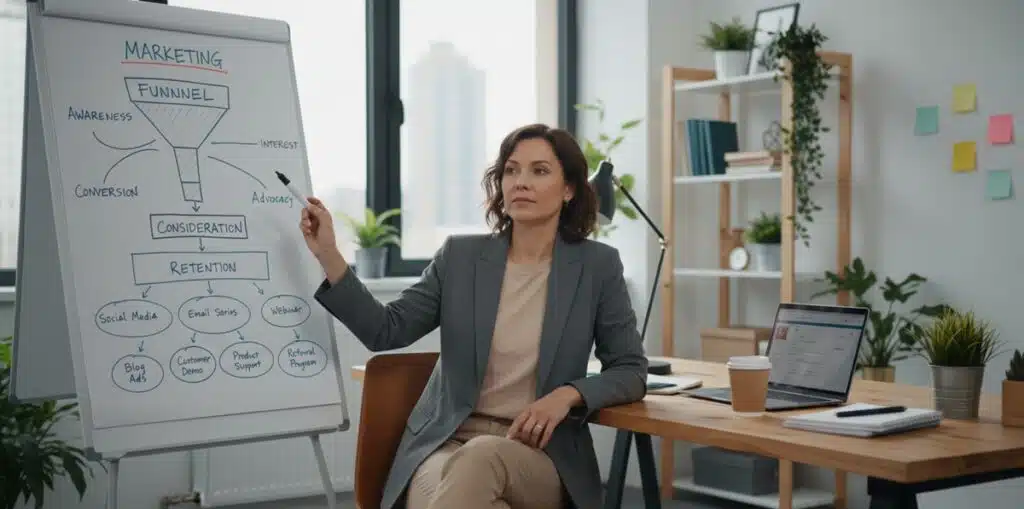
A marketing funnel is a strategic model that visualizes the customer’s journey from their first point of awareness to the moment they make a purchase. By understanding this path, you can align your marketing activities to meet your audience’s needs at each stage. For a solopreneur, this framework turns marketing from a random to-do list into a purposeful system.
Let’s break it down into three simple stages:
Stage 1: Top of Funnel (TOFU) – Awareness & Attraction
- Goal: Attract a wide audience of potential customers who have a problem you can solve, but may not know you exist yet.
- Their Mindset: “I have a problem, and I’m looking for information.”
- Your Role: Be the helpful expert. Create valuable, educational content that answers their questions without a hard sell.
Stage 2: Middle of Funnel (MOFU) – Consideration & Nurturing
- Goal: Convert visitors into leads by capturing their contact information (usually an email address). Nurture the relationship and build trust.
- Their Mindset: “I’m evaluating different solutions. Who can I trust to help me?”
- Your Role: Be the trusted guide. Offer more in-depth resources in exchange for their email, and use email marketing to demonstrate your expertise and unique value.
Stage 3: Bottom of Funnel (BOFU) – Conversion & Delight
- Goal: Convert leads into paying customers.
- Their Mindset: “I’m ready to make a decision. Why should I choose you?”
- Your Role: Be the obvious choice. Make a clear, compelling offer that solves their problem, backed by testimonials and a smooth purchasing process.
Now, let’s map the vast world of digital marketing tactics onto this powerful framework.
The Complete Arsenal: Types of Online Marketing for Solopreneurs
Here is a comprehensive breakdown of every major digital marketing channel. We’ll explore what each one is and, more importantly, how it fits into your solopreneur funnel. Instead of a random list of tactics, think of this as your strategic playbook for choosing the right tool for the right job at the right time.
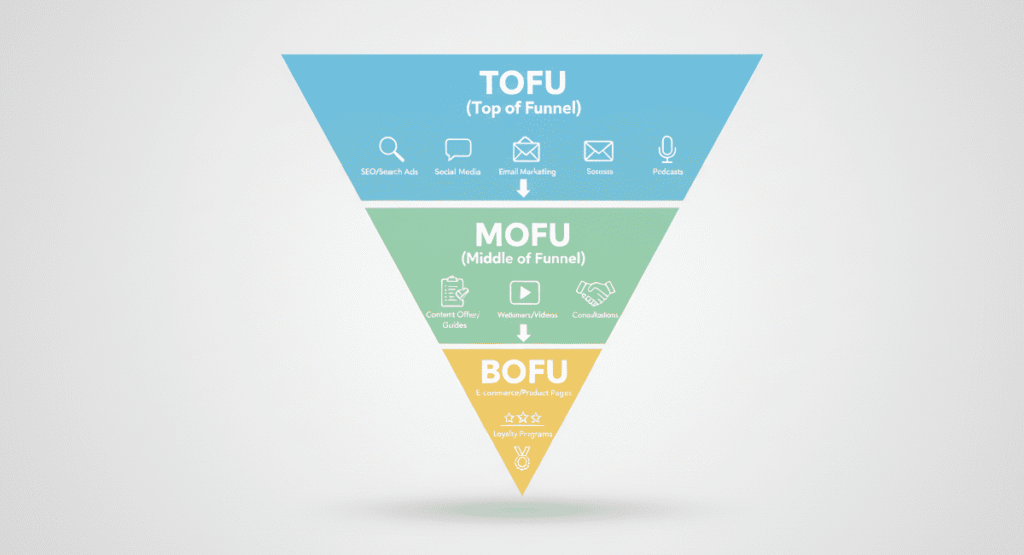
Channels for the Top of the Funnel (TOFU): Getting Discovered
Your primary goal at this stage is attraction. You need to reach potential customers who are problem-aware but may not be solution-aware or brand-aware. These channels are designed to build visibility and draw a wide audience to your digital doorstep.
Search Engine Optimization (SEO)
- What it is: The practice of optimizing your website and content to rank high on search engines like Google for specific keywords. This includes On-page SEO (optimizing content), Off-page SEO (earning backlinks), and Technical SEO (site speed and structure).
- The Solopreneur Angle: SEO is your single most important long-term strategy. It delivers free, consistent, high-intent traffic from people actively searching for solutions you provide. Instead of chasing customers, they come to you.
Content Marketing
- What it is: The creation and distribution of valuable, relevant content (blogs, videos, podcasts, guides) to attract, educate, and retain your ideal audience.
- The Solopreneur Angle: Content is the fuel for your entire funnel. It’s how you demonstrate expertise, build trust, and power your SEO efforts. A single “pillar” blog post can be repurposed into dozens of social media updates, a video script, and a newsletter, maximizing your time investment.
Social Media Marketing (Organic)
- What it is: Building a brand presence and engaging with a community on platforms like LinkedIn, Instagram, Facebook, or X (formerly Twitter) without paying for ads.
- The Solopreneur Angle: Don’t try to be everywhere. Choose the one platform where your ideal clients hang out and go deep. Use it for authentic conversation and connection, sharing your content and personality. It’s about community, not just broadcasting.
Video Marketing
- What it is: Using video to educate, entertain, and engage your audience. This includes long-form content on YouTube, short-form videos like Instagram Reels or TikToks, and product demos.
- The Solopreneur Angle: Video is unmatched for building a personal connection—your audience can see and hear you. Short-form video, in particular, offers massive organic reach and is a powerful tool for introducing your brand to thousands of new people quickly.
Influencer Marketing
- What it is: Partnering with creators or influential figures in your niche to promote your product or service to their established, trusting audience.
- The Solopreneur Angle: Focus on micro-influencers (5k-50k followers). They are more affordable, have highly engaged niche audiences, and their endorsement provides powerful social proof that can drive targeted traffic to the top of your funnel.
Online PR (Public Relations)
- What it is: The digital equivalent of traditional PR, focused on gaining mentions, features, and backlinks from online publications, blogs, and podcasts.
- The Solopreneur Angle: This is more accessible than you think. Use services like Help a Reporter Out (HARO) to provide expert quotes to journalists. A single feature on a reputable site can dramatically boost your credibility and SEO authority.
Community Marketing
- What it is: Actively engaging with potential customers in online communities where they are already gathered, such as Facebook Groups, Reddit, Discord, or Quora.
- The Solopreneur Angle: Instead of trying to build an audience from scratch, go where the conversations are already happening. Be genuinely helpful, answer questions, and establish yourself as a resource. This builds immense goodwill and gently leads people to discover your business.
Local Online Marketing
- What it is: A specialized set of strategies focused on attracting customers in a specific geographic area, with a heavy emphasis on local SEO.
- The Solopreneur Angle: If your business serves a local clientele (e.g., photographer, consultant, therapist), this is mission-critical. Your cornerstone is your Google Business Profile (GBP). A fully optimized GBP is often the very first thing a local customer sees when they search for your services.
Channels for the Middle of the Funnel (MOFU): Building Relationships
Once you’ve attracted visitors, the goal shifts to conversion—not into customers yet, but into leads. This stage is all about building trust and capturing contact information so you can nurture the relationship directly.
Email Marketing
- What it is: Communicating directly with leads and customers via email through newsletters, promotional campaigns, and automated sequences (drip campaigns).
- The Solopreneur Angle: Your email list is your single most valuable marketing asset. You own this audience, safe from unpredictable social media algorithms. Use it to deliver value, build a deep connection, and guide subscribers toward your paid offers.
Landing Pages: The Bridge to Conversion
- What it is: A standalone web page designed for a single, focused objective—usually to capture a lead via a form in exchange for a valuable offer (a lead magnet).
- The Solopreneur Angle: Never send traffic from an ad or a specific promotion to your homepage. A dedicated landing page removes all distractions and dramatically increases the chances a visitor will give you their email address, making it the essential bridge between your TOFU and MOFU efforts.
Remarketing / Retargeting
- What it is: Showing targeted ads to people who have already visited your website but didn’t take a desired action (like signing up or buying).
- The Solopreneur Angle: This is one of the most cost-effective forms of paid advertising. The audience is “warm” because they already know you. A simple remarketing campaign showing an ad for your lead magnet can be incredibly effective at bringing curious visitors back into your funnel.
Channels for the Bottom of the Funnel (BOFU): Driving Action
This is the final stage where you convert nurtured leads into paying customers. The messaging here is more direct, focusing on your specific offer and why you are the best choice.
Search Engine Marketing (SEM)
- What it is: Paid advertising on search engines, also known as Pay-Per-Click (PPC). You bid to have your ad (e.g., Google Ads) show up when users search for specific keywords.
- The Solopreneur Angle: While SEO is a long game, SEM delivers immediate results. It’s perfect for the bottom of the funnel. You can run ads targeting “buying intent” keywords (e.g., “hire a business coach”) to capture people who are actively ready to make a decision.
Social Media Advertising (Paid Social)
- What it is: Running paid ad campaigns on platforms like Facebook, Instagram, and LinkedIn to reach a highly specific audience beyond your organic followers.
- The Solopreneur Angle: The hyper-specific targeting is a solopreneur’s dream. You can show ads directly to people based on their job titles, interests, or online behaviors. Use paid social to promote a direct offer, a webinar, or a consultation to your most qualified leads.
Conversion Rate Optimization (CRO)
- What it is: The systematic process of improving your website and landing pages to increase the percentage of visitors who take a desired action (e.g., buy a product, book a call).
- The Solopreneur Angle: CRO is how you make more money from the traffic you already have. It’s about making small, data-driven tweaks like A/B testing headlines or changing a button color. This focus on efficiency is key when your resources are limited.
E-commerce Marketing
- What it is: A specific suite of strategies for promoting and selling products through an online store.
- The Solopreneur Angle: If you sell physical or digital products, this is your BOFU focus. Key tactics include abandoned cart emails (automated reminders), running Google Shopping ads, and using dynamic product ads on Facebook to show users items they’ve previously viewed.
Foundational Strategies: Tools That Span the Funnel
These aren’t standalone channels but rather powerful strategies and tools that amplify your efforts across all stages of the funnel.
Marketing Automation
- What it is: Using software (like Mailchimp, ConvertKit, or Zapier) to automate repetitive marketing tasks such as email sequences, social media posting, and lead segmentation.
- The Solopreneur Angle: This is your secret weapon for scaling yourself. Automation allows you to create sophisticated, personalized customer journeys that run 24/7 without your direct involvement, freeing you to focus on high-value work.
Affiliate Marketing
- What it is: A performance-based model where you pay a commission to others (affiliates) for referring new customers to you.
- The Solopreneur Angle: This is a low-risk way to create a sales team you only pay for results. By empowering happy customers and partners to promote your products for a commission, you can tap into their audiences and grow your reach exponentially.
Mobile Marketing
- What it is: A strategy that recognizes most users will interact with your marketing on a smartphone. It encompasses everything from having a mobile-responsive website to leveraging direct messaging platforms. This includes traditional SMS marketing as well as using increasingly popular tools like WhatsApp.
- The Solopreneur Angle: This is less a separate channel and more a critical filter you must apply to everything you do. Your website must be flawless on mobile. Your emails must be readable on a small screen. Your landing pages must be easy to fill out with a thumb. Furthermore, platforms like the WhatsApp Business app offer a powerful, direct line to your most engaged customers. For a solopreneur, this channel is perfect for providing personalized support, sending timely updates, or sharing exclusive offers with open rates that far surpass email. It transforms marketing from a broadcast into a one-on-one conversation, which is a solopreneur’s unique advantage. A mobile-first mindset is non-negotiable.
The Growth Marketing Mindset: Experiment, Learn, Iterate
Now that you understand the channels, it’s time to adopt the mindset of a growth marketer. Instead of just “doing marketing,” you’ll be running a series of small experiments to see what drives results.
- Hypothesize: “I believe that changing my landing page headline from ‘Learn to Code’ to ‘Become a Job-Ready Developer in 90 Days’ will increase sign-ups.”
- Test: Run an A/B test showing 50% of your visitors the old headline and 50% the new one.
- Analyze: After a set period (e.g., 1,000 visitors), check the data. Did the new headline win?
- Iterate: If it won, make it the new default. If it lost, you learned something valuable. Form a new hypothesis and test again.
This data-driven approach eliminates guesswork from digital marketing for solopreneurs, ensuring your efforts continually improve over time.
Your Unpaid Intern: Leveraging AI in Your Marketing

The rise of Artificial Intelligence is the single biggest advantage a modern solopreneur has. AI tools can handle tasks that once required a team, freeing you up to focus on strategy and client work.
Here’s how to use AI as your marketing co-pilot:
Content Ideation & Creation:
Prompt for ChatGPT: “Act as a digital marketing strategist. Give me 10 blog post ideas for a freelance graphic designer targeting tech startups. For each idea, provide a catchy headline and a 3-point outline.”
Ad Copywriting:
Prompt for Jasper.ai: “Write 5 compelling Facebook ad headlines for a webinar on ‘Mastering Your Finances as a Solopreneur.’ Use the AIDA (Attention, Interest, Desire, Action) framework.”
Social Media Management:
Prompt for ChatGPT: “Take this blog post [paste text] and turn it into 5 engaging tweets and a 3-point summary for a LinkedIn post.”
Graphic Design:
Use Canva’s Magic Studio to generate professional-looking social media graphics, ad creatives, and presentations from a simple text prompt.
SEO & Research:
Prompt for Perplexity AI: “What are the most common pain points for new parents trying to sleep-train their baby? List them and cite your sources.” This is excellent for understanding customer needs for content creation.
For a deeper dive into AI’s impact, publications like Marketing AI Institute offer cutting-edge insights.
Overcoming the Solopreneur’s Greatest Foes
Even with the best strategy, the solo journey has its challenges. Acknowledging them is the first step to conquering them.
- Limited Time: You can’t do it all. The solution is ruthless prioritization (using your funnel) and automation. Batch your tasks—write four blog posts in one day, then schedule them out.
- Limited Budget: You don’t have a corporate credit card. The solution is to focus on organic, “sweat equity” channels like SEO and content marketing first. They take time but build a lasting asset. Only use paid ads once you have a proven, profitable offer.
- Burnout: The weight of every role is heavy. The solution is to set realistic goals, celebrate small victories, and protect your time off. Your business cannot thrive if you don’t.
Conclusion: Your Path Forward
Mastering digital marketing for solopreneurs is not about implementing all of the strategies at once. It’s about understanding the landscape, building a solid funnel-based strategy, and then selecting the 2-3 tactics that best fit your strengths, business, and audience at this time.
Start with your foundation: a deep understanding of your customer and a professional website. Then, build your TOFU engine with consistent content and SEO. Capture leads with a compelling landing page and nurture them with email. Finally, when you’re ready, experiment with paid channels to accelerate your growth.
You have a superpower that no large corporation can replicate: you. Your authenticity, your story, and your direct connection with your customers are your greatest marketing assets. Embrace them, combine them with this strategic framework, and you won’t just build a business—you’ll build an empire of one.
Feeling empowered but need a clear starting point? Map out your first three marketing steps and turn this knowledge into action.
Frequently Asked Questions (FAQ)
As a solopreneur, where should I start with digital marketing?
Start with your foundation. First, deeply define your ideal customer. Second, build a professional, mobile-friendly website. Third, choose ONE top-of-funnel channel you can be consistent with (e.g., blogging for SEO or creating short-form videos) and start creating valuable content.
What is a simple marketing funnel for a service-based solopreneur?
A classic and effective funnel is: 1) Awareness (TOFU): Create helpful blog posts or videos that answer common client questions. 2) Consideration (MOFU): Offer a free PDF checklist or guide on your website in exchange for an email address. 3) Conversion (BOFU): Use an automated email sequence to build trust and then offer a free 15-minute consultation call.
What’s the difference between SEO and SEM?
SEO (Search Engine Optimization) is the organic process of improving your site to rank higher in search results for free. SEM (Search Engine Marketing) is a broader term that includes SEO but is most commonly used to refer to paid search advertising (like Google Ads). SEO is a marathon; SEM is a sprint.
How much should a solopreneur budget for marketing?
There’s no single answer, but a common guideline is 5-10% of your target revenue. However, when you’re starting, your budget might be $0. In that case, your entire budget is your time, which you should invest in organic strategies like content, SEO, and community engagement.
How can I create landing pages without being a tech expert?
Use user-friendly landing page builders like Leadpages, Instapage, or Carrd. These platforms offer drag-and-drop editors and templates, allowing you to create high-converting pages in under an hour with no coding required.
Is social media a waste of time for a solopreneur?
It can be if you don’t have a strategy. It’s a waste of time if you try to be on every platform or post without a purpose. It’s a powerful tool if you choose one platform, engage in real conversations, and use it to drive traffic to your website where you can capture leads.
How do I measure the ROI of my digital marketing for solopreneurs?
Use free tools like Google Analytics. Set up conversion goals to track how many people sign up for your email list or fill out a contact form. By tracking where these conversions come from (e.g., Google search, Instagram, etc.), you can see which channels are providing the best return on your investment of time and money.
What’s the fastest way to get my first customers using digital marketing?
While long-term strategies like SEO are vital, the fastest way is often direct outreach or targeted ads. Use LinkedIn to connect with ideal clients or run a small, highly-targeted Facebook ad campaign to a landing page with a compelling offer. This gets your message in front of the right people immediately.